


The Numbers Behind Applying for Jobs
For those who have job searched in the past, are currently in the process of doing so or have just ever had experience doing so, it can definitely feel like our applications are thrown in a black hole sometimes. As someone in that position recently, I decided to create a quick dataset on my experience as I job searched. For those interested in my path before the actual analysis, please keep reading! Otherwise, you can skip ahead to the next section for the actual analysis.
Back in college I took a course in Statistical Data Mining during my last semester of undergrad and fell in the love with it's intersection of mathematics, computer science and business acumen to drive actionable insights. As a result, I loaded up on courses related to machine learning and AI during my time as a Masters student. After college, I found myself working at Workday Student as their mission to revolutionize student information systems and empower students aligned with my passion to use technology to better the lives of people.
Over time, I found that I never had the chance to really use my abilities or knowledge in analytics so I started this blog to practice and learn more. I knew that if I wanted to make the move over to a new industry, I'd have to spend a good chunk of personal time studying so I for a few months I spent hours at night studying, reading different blogs, taking coding challenges and pouring over others' Jupyter notebooks all while working to stand up a customer at work. Over time as I became more confident in my self-taught Pandas, NumPy, SQL, seaborn and other analytics staples I found myself ready to interview and so I began tracking every position I applied to.
The Data
Once I knew I was to start applying to new positions and interviewing, I began tracking some information about every role I applied to. This included information like:
Role/Title
Minimum Years of Experience
Skills/technologies marked as core/necessary skills
Skills/technologies marked as "nice to have"s
The date I applied to the role
The date that I received a response and whether a phone screen would be scheduled or not
Whether I moved on to a technical phone screen/onsite/offer
The Roles
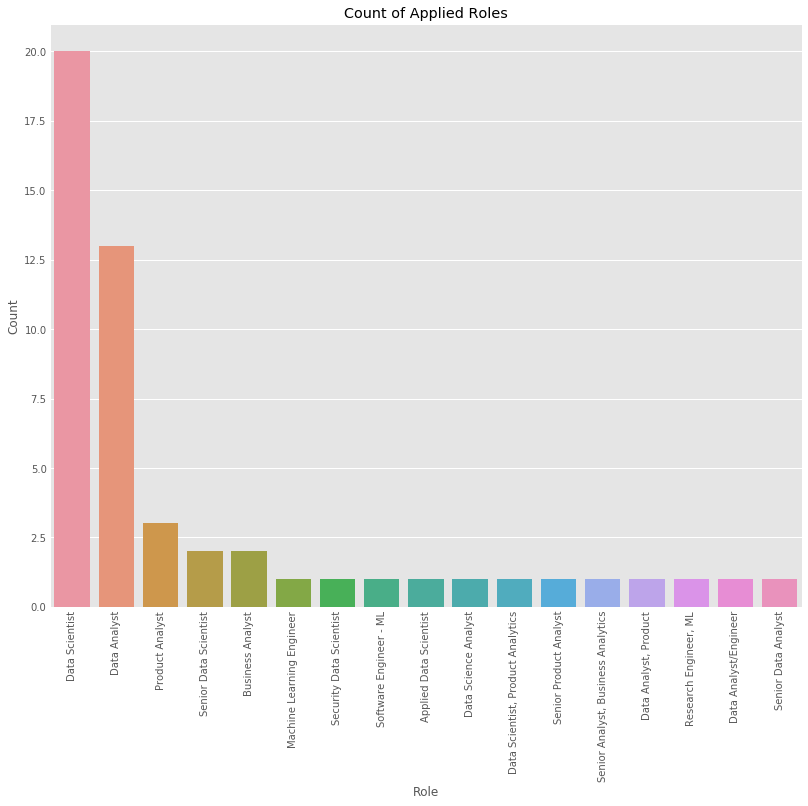
Down below we can see the number of roles specific roles I applied to our of the 52 positions that I submitted an application for over the span of 2 months or so. The most common roles are for either a Data Scientist or Data Analyst with most others being some variation on those two with a bit more specificity or seniority.
To better understand the variety in roles that I was applying to, I wanted to break them down by some different factors. The first was understanding the distribution of minimum number of years of experience for the roles I was applying to.
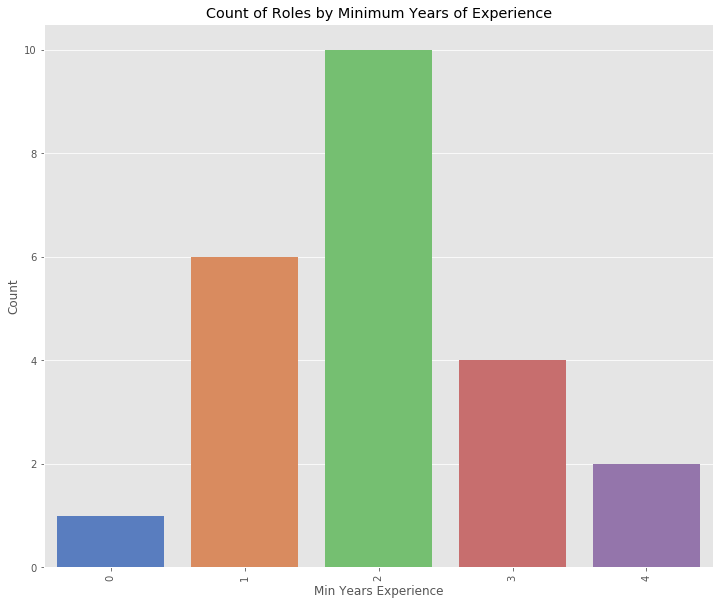
I told myself when I started applying that I would try not to be too ambitious with the roles I was applying to in terms of years of experience as I technically did not have any professional experience in analytics. From the graph above it seems like I was relatively consistent in picking out roles that were mostly 1-2 years of minimum experience though this might also be because that seems to be the common minimum years of experience that most entry level positions list.
From there, I wanted to understand the breakdown of skills by role. For anyone interested analytics/data science industry, you'll quickly find that the core analytics toolbox consists of Python, SQL and R. From there, more data engineering focused roles might seek applicants who are familiar with Spark, Hadoop and other data processing tools. Some other tools like Tableau and Looker also make an appearance for analytics/BI focused roles and even new languages like Julia have surfaced in requirements. Overall, I tracked for every role I applied to what the required skills were as well as what were considered nice-to-haves/pluses.

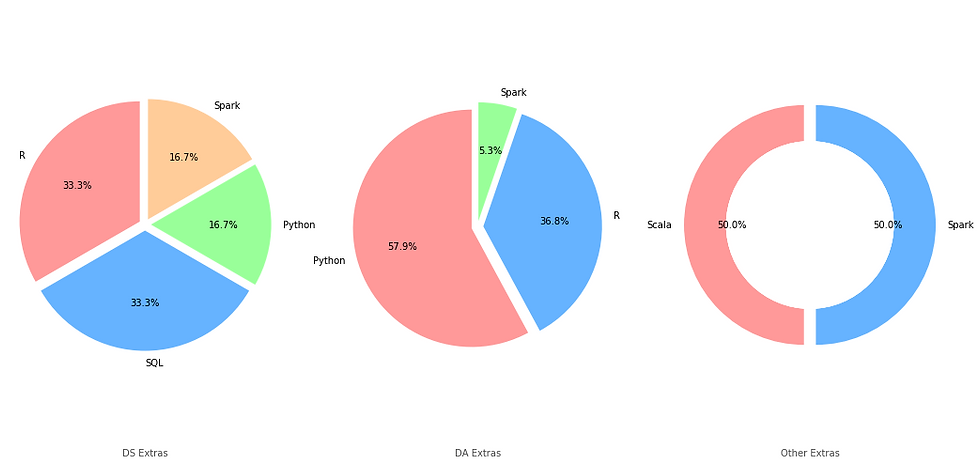
From the graphs above, it's interesting to see how DS positions focus on Python as a core requirement whereas DA skills focus more on SQL and then list Python as an extra. Spark makes an appearance in all 3 types of a roles as a nice-to-have as well. Unsurprisingly data scientists will commonly be working with Pandas, NumPy and scikit-learn among other data science-focused packages to conduct analyses whereas data analysts may be more focused on wrangling data from data stores.
The Responses
Of my 52 applications, the majority of companies (52%) never responded to me so the feeling of throwing an application into a black hole is definitely merited. From there, 56% of responses were to not move forward with a phone screen. Overall, only roughly 21% of my applications actually ended up in a phone screen or initial call so the feeling that I rarely heard back or that it was usually a rejection when I did hear back was not unjustified.
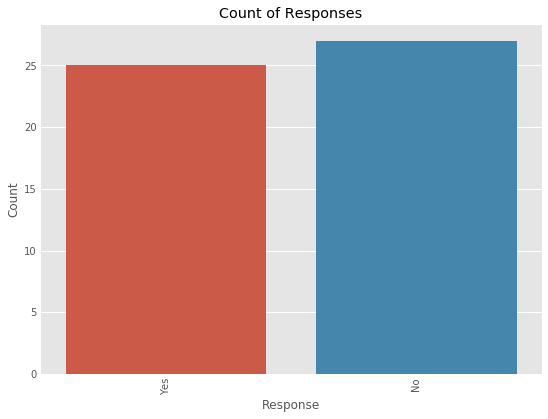
I had a strong feeling when I applied to analytics related positions that I would have an uphill battle soliciting initial phone screens. As someone who spent the last 4 years in application development, I could totally understand why a recruiter might be wary of my skills. However, I also had a strong feeling that if I managed to get my foot in the door to receive a technical screen that I would be able to showcase my skills in a take-home analytics test or on-site test.
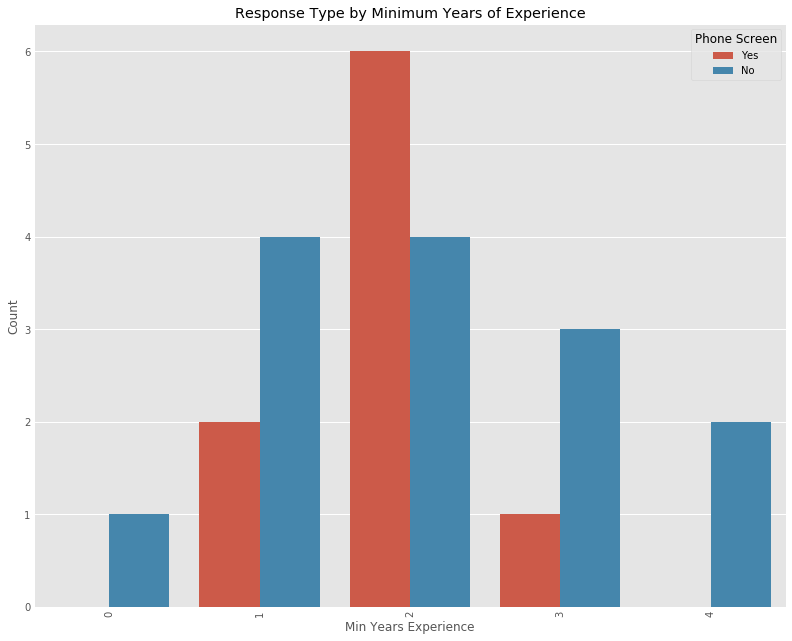
I tried to be relatively realistic about applying to roles in terms of years of experience as I technically did not have any professional years of experience in the industry. It seems that I did a relatively decent job at this as most of the roles that I applied to required only 1-2 years of experience at a minimum. This may very well also be because it's most realistic number to put as a minimum in terms of entry level positions. I had the most luck in terms of receiving a response that resulted in a phone screen for roles listing a minimum of 2 years of experience.
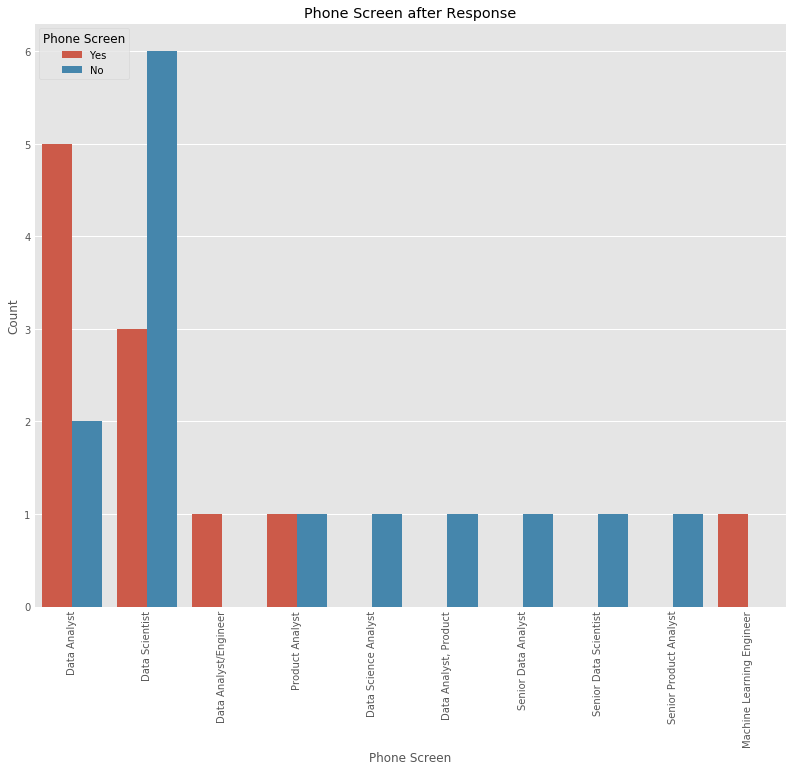
From there, I got a breakdown of responses by the type of role I was applying to. It became a little more apparent here that my lack of experience in the industry was holding me back from greater success in terms of getting phone screens as a data scientist which was totally understandable. I had no luck with any role marked "senior" and had the most positive response to analyst related roles.
Something I had noticed as the responses rolled in was that it felt like positive responses that resulted in a phone screen always felt like they came way sooner than those that ended up in rejection. To capture this, I also recoded a column for a when a response was sent so I could compare the amount of time between application and response.
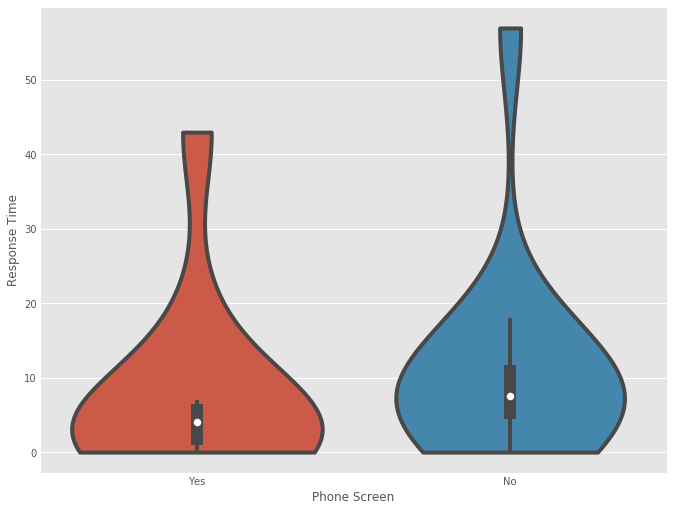
From the above it becomes apparent that a qualitative gut feeling could actually be quantified. The median response time for an application that resulted in a phone screen was 4 days while the mean was 7.7 whereas the median response time for a reject was 7.5 with a mean of 11.2. After applying for roughly 2 months and hearing back from recruiters a few times, I started acknowledge that if a certain window had passed in terms of response time, any subsequent response would likely be a rejection.
In the end, I ended up having about 6 on sites that led to 3 fantastic offers that. Here are the high level stats that got me there to phone screens:
Only 48% of my applications received a response of any kind
21% of my applications led to a phone screen
Of all the responses I received, 44% were for a phone screen
Once I was past phone screen stage:
55% of my phone screens led to an onsite
50% of my onsites resulted in an offer
I knew that the biggest challenge for myself going into all these interviews was just getting my foot in the door for an interview because of my glaring lack of experience in the field but I was confident that I had the skills and ability to learn all the tools for the job quickly. After multiple onsites, coding tests and take-home data sets, in the end I had 3 fantastic offers from Cruise Automation, Thumbtack and Envoy.
Where I am now
After some debate, I made the decision to join Envoy to revolutionize the office! I loved every person I talked to, the trajectory of the company and the size of the company which would allow me to learn a ton while wearing a variety of different hats. As a member of a small team, I get a lot of opportunity to experience data engineering, analytics and science as the team grows as well as define standards and practices around data cleaning, integrity and consumption.
As always, you can find the Jupyter notebook here: Job Application Analysis
Comments